31 August 2026
SUMMER INTERNSHIP DEVELOPS A METHODOLOGY TO ASSESS THE CARBON FOOTPRINT OF AMMONIA PRODUCTION AT R&D NESTER
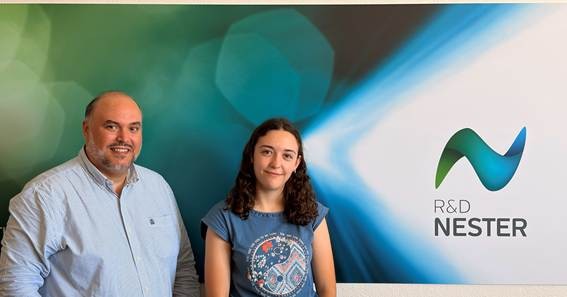
Between 6 July and 28 August 2026, Sofia Lopes, a Master’s student in Mechanical Engineering at Instituto Superior Técnico, completed a summer internship at R&D Nester focused on the production of ammonia from green hydrogen.
The main objective of the internship was to support the development of a methodology and calculation model for assessing the carbon footprint of green ammonia, while establishing a comparable baseline for conventional production routes.
During the internship, life cycle assessment methodologies, international standards and European regulations applicable to renewable and low-carbon fuels were analysed.
Based on this framework, a model was developed covering the main stages of ammonia production, including electricity supply, hydrogen production, nitrogen separation, ammonia synthesis, refrigeration and storage.
Consumables, maintenance, water use, transport and fugitive emissions were also considered.
The methodology enabled the comparison of different production configurations, ranging from electrolysis powered by wind, solar or grid electricity to production based on steam methane reforming (SMR), with or without carbon capture and storage.
The results demonstrated that the source of electricity and the technology used to produce hydrogen are key determinants of the final carbon footprint of ammonia.
Among the scenarios analysed, electrolysis powered by wind electricity achieved the lowest carbon footprint.
The sensitivity analysis also assessed different combinations of wind, solar and grid electricity, identifying the energy configurations with the greatest potential for renewable or low-carbon ammonia production.
The work resulted in a carbon footprint accounting model and a LCA methodology, including a sensitivity analysis of several key parameters.
These results strengthen R&D Nester’s capabilities in assessing solutions for industrial decarbonisation and establish a basis for future studies on integrated electricity, hydrogen and ammonia systems.
Throughout the internship, Sofia Lopes enhanced her skills in life cycle assessment, emissions accounting, industrial process modelling, sensitivity analysis and European regulation, through an experience that brought together energy, environmental and process engineering.